US EV Manufacturing in 2026: Why Execution, Not Capacity, Will Define the Next Winners
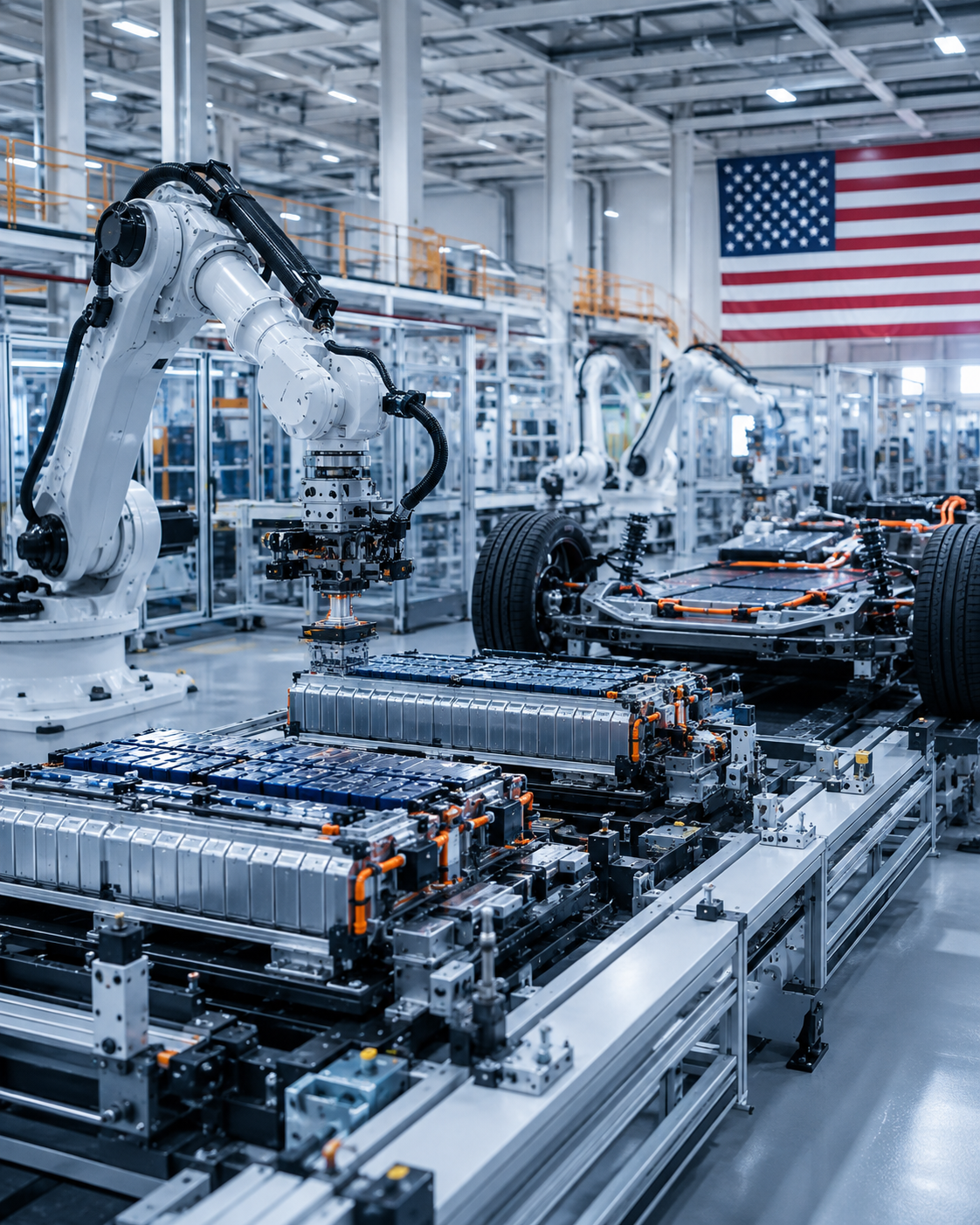
Research Brief | Electric Vehicles & Batteries | August 2026
For the past several years, the US electric vehicle story has been dominated by factory announcements, new battery plants, incentives and billions of dollars of committed investment.In 2026, the focus is shifting.The United States has already created a substantial EV and battery manufacturing base. The more important question now is whether that base can operate competitively.Manufacturers are entering a phase in which plant utilisation, manufacturing yield, vehicle affordability, battery chemistry and supply-chain execution matter more than announced capacity alone.
EV demand is becoming more fragmented
Electrification remains an important part of the US automotive market, but the demand curve is no longer moving in one direction.Battery electric demand weakened following the end of federal purchase credits in September 2025, while conventional hybrids continued to gain ground.Consumers are not necessarily moving away from electrification. They are becoming more selective about which form of electrification best fits their economics and usage needs.Purchase price, financing, charging access, residual value and expected driving patterns increasingly influence the choice between battery electric, plug-in hybrid and conventional hybrid vehicles.For manufacturers, this makes demand planning more complex and increases the value of flexible production systems.
The race is moving from building factories to running them well
The first phase of US battery localisation was about capacity creation.The next phase is about execution.New battery facilities have moved into production, including major investments by Panasonic Energy and Toyota.But installed capacity is not the same as economically productive capacity.A battery plant must reach acceptable yield, maintain quality, secure sufficient customer demand and operate at utilisation levels capable of supporting a very high fixed-cost base.This means one distinction is becoming increasingly important:Operating output, qualified capacity, capacity under construction and announced capacity should not be treated as equivalent.Each represents a very different level of commercial certainty.
Affordability is becoming an industrial issue
The next stage of EV growth will not be driven by battery cost alone.Vehicle architecture, manufacturing complexity, chemistry, component count and assembly processes increasingly need to be addressed together.Lower-cost chemistries such as lithium iron phosphate, or LFP, are becoming more relevant for value-oriented applications, while higher-nickel chemistries continue to serve segments where range and performance justify their economics.The market is therefore unlikely to converge around one battery chemistry.Instead, chemistry is becoming a portfolio decision linked to vehicle-segment economics.
Manufacturing flexibility is becoming a competitive advantage
If demand is less predictable, factories need to become more adaptable.Manufacturers that can serve multiple powertrains, battery chemistries, vehicle segments or adjacent battery markets are better positioned to protect utilisation when demand shifts.Toyota's US strategy illustrates this approach, with manufacturing investments spanning hybrids, plug-in hybrids and battery electric vehicles.This points to a broader industry shift.Flexibility is becoming a form of capital-risk management.The strongest platforms may be those designed for optionality before demand changes, rather than those forced into expensive retrofits after utilisation has already weakened.
Domestic manufacturing does not automatically mean a domestic supply chain
US cell manufacturing capacity is growing, but important parts of the battery value chain remain globally concentrated.Critical minerals, processing, cathode and anode materials, cells, packs, recycling and compliance systems all influence the economics and resilience of the finished battery.A battery factory located in the United States can therefore still depend heavily on imported materials, equipment and technical expertise.At the same time, this creates another layer of opportunity.Materials processing, traceability, recycling, production controls and compliance capabilities are becoming increasingly important parts of the US battery ecosystem.The opportunity surrounding the factory may become almost as strategically important as the factory itself.
Competition is becoming ecosystem competition
Vehicle manufacturing can no longer be assessed independently from batteries.And batteries cannot be assessed independently from materials, charging, financing, software and lifecycle economics.The competitive unit is increasingly becoming the ecosystem.Some companies are pursuing greater vertical integration. Others are relying on joint ventures, technology partnerships and diversified manufacturing footprints.The strongest competitive positions are likely to belong to companies that can coordinate vehicle design, battery chemistry, sourcing, manufacturing, charging and customer economics as one system.
What comes next?
The next phase of the US EV and battery market will not be defined by one headline growth number.The opportunity is becoming broader and more operational.Affordable electric vehicles remain important. So do hybrids. Domestic battery manufacturing is expanding, but stronger materials and recycling ecosystems are still required. Charging infrastructure remains an execution challenge, while commercial fleets, energy storage and battery lifecycle services can create additional demand.The strongest market positions through the end of the decade are therefore unlikely to belong simply to companies with the largest announced capacity.They are more likely to belong to platforms that combine:affordable vehicles, flexible battery production, resilient sourcing, reliable charging and lifecycle services.The US has largely answered the first question in its EV transition:Can a domestic industry be built?The harder question is now:Can it be made competitive?That is likely to define the next chapter of the US electric vehicle and battery manufacturing market.
This article draws on analysis from Smart Research Insights' “Assessment of the US Electric Vehicle and Battery Manufacturing Market 2026.” The full study examines market structure, demand drivers, manufacturing economics, battery technologies, competitive positioning, supply-chain development and emerging opportunity areas.Smart Research Insights | Go For Growth